


BoulderPlay: Creating interactive bouldering experiences using AR
Design collaboration & student co-supervision
February-May 2024
Monash University
Bouldering is an increasingly popular sport (I enjoy regular bouldering sessions as well). The appeal of bouldering lies in its easy entry: you do not need any safety equipment to climb indoors, given the presence of thick sports matting. Additionally, bouldering combines puzzle solving with strength, stamina, balance, coordination and agility. However, bouldering walls are generally static – route setters determine a route and this route does not change dynamically while climbing. Even in interactive walls like Kilter boards and Moon boards, the route remains unchanged while climbing. We saw an opportunity to introduce dynamic routes by using augmented reality (AR), which changed the puzzle solving and stamina aspects of bouldering. BoulderPlay was developed within a student project, where I co-supervised three students, guiding them through the design and prototyping process and offered guidance and support during participant research.
Using augmented reality to create dynamic routes
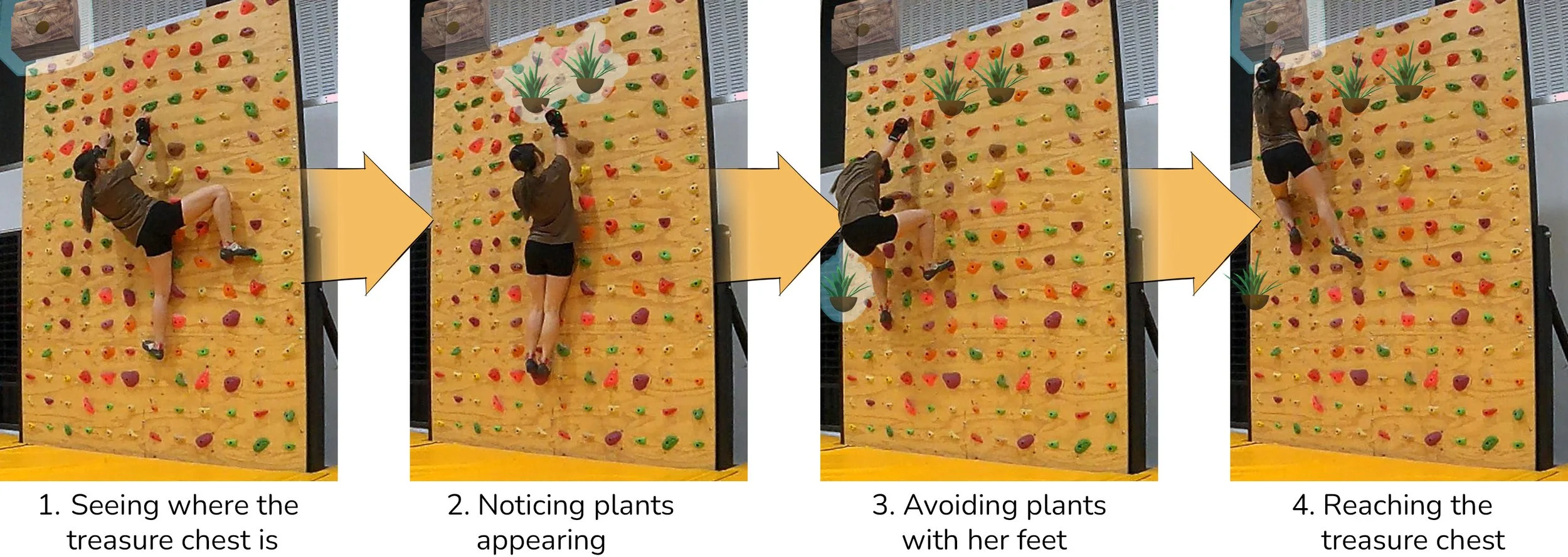
We developed BoulderPlay, an AR game that is played by a climber, who wears an AR headset, and an opponent (in this study, a researcher), who operates a laptop on the ground. The game is played on a spray wall – a wall with scattered holds with no predetermined routes. The climber’s goal is to reach the treasure chest at the top of the wall. The opponent’s goal is to block the climber from reaching the treasure chest by placing digital plants on the wall. Because of the use of augmented reality, it looks as if these plants stick out from the wall, creating 3D obstacles while climbing. The climber needs to avoid these prickly plants: the AR headset’s hand tracking detects that the climber is touching a plant, they feel that as a vibration on their forearms.
This video accompanied the Work-In-Progress paper: "BoulderPlay": Exploring AR and Vibrotactile Integration for Novel Bouldering Experiences. This work was presented at SportsHCI 2025.

Outcomes
BoulderPlay’s gameplay created routes that changed as the climber progressed on the wall, which resulted in routes that felt longer and more challenging than a predetermined route. The climbers who tried BoulderPlay welcomed the stamina challenge and thought the gameplay challenged them to quickly come up with new routes.
BoulderPlay provides an example of the use of augmented reality headsets in a bouldering setting. Augmented reality augmentations offer more variation in challenges because of the use of 3D artefacts, especially when combined with embodied feedback like vibrations. Additionally, because the wall is left physically unchanged, the use of an AR headset and other wearables offers a relatively low-cost way to investigate the use of interactive bouldering systems within a commercial gym. Finally, BoulderPlay has the potential to become a multi-player game, where two climbers place plants on each other’s routes.
Publications related to this project
Overdevest, N., Tariq, A., Qian, G., Welstead-Cloud, E., Wang, P.-Y. “Cosmos,” Daiber, F., Kosmalla, F., Mueller, F. & Elvitigala, D. S. (2025). “BoulderPlay”: Exploring AR and Vibrotactile Integration for Novel Bouldering Experiences. Proceedings of the First Annual Conference on Human-Computer Interaction and Sports, SportsHCI ’25. https://doi.org/10.1145/3749385.3749409